How Cork7 rotation points work
The rotation base is 500 × turns². A 180 counts as half a turn; a complete flip counts as one. When spins and flips are combined, the game uses the larger turn count plus half the smaller one.
| Completed rotation | Rotation base |
|---|---|
| 360 or one flip | 500 |
| 720 or two flips | 2,000 |
| 1080 or three flips | 4,500 |
These are base components, so the number shown after a complete trick can differ. Use the table to compare rotation itself. Adding a grab, changing stance or landing differently brings other scoring terms into the result.
Add grab variety before adding more rotation
The three grab inputs are Shift for mute, Q for tail and E for Japan. Each different grab held for at least 0.25 seconds adds 100 points and another 25% of the rotation base. Holding the same grab again does not create another variety step.
For example, a 720 spin before stance or off-axis bonuses starts with 2,000 rotation points. Two qualifying grab styles raise that portion to 3,000, then add 200 grab points. That is a subtotal: airtime, hold duration, height and landing terms still affect the finished result.
Practice the grabs separately so you can recognize each pose. Once you can complete a familiar jump comfortably, alternate two styles on the same feature. Compare the replay and scoring readout rather than assuming every brief button tap registered.
Keep the line alive and understand the bonuses
Qualified grab holds add 280 points per second. Airtime contributes 45 per second plus 12 per metre of peak height. Switch and off-axis rotation have multipliers of 1.25 and 1.3 respectively. Each extra air or rail link increases the line multiplier by 0.25; a clean landing adds 150 plus 15%.
Repeated airs fall to 75%, then 55%, then 40% of their trick points and grab-variety bonus. Snow landings bank a line; a bail loses that line. A sequence of varied, manageable features is therefore a useful practice target. Choose your next feature while you still have time to approach it, and leave a difficult jump out if it keeps ending the run.
A practice routine for your first cork
- Land a straight jump and learn where the run-in leads.
- Repeat it with a small spin. Get comfortable releasing the input before landing.
- Add one held grab while keeping the rotation familiar.
- Combine A or D with S to try a cork.
- Watch the replay and change one part of the attempt at a time.
Use the result as feedback. If the added rotation makes the landing hard to read, return to the simpler version for another lap. Keeping your approach consistent helps you compare attempts without guessing which of several changes mattered.
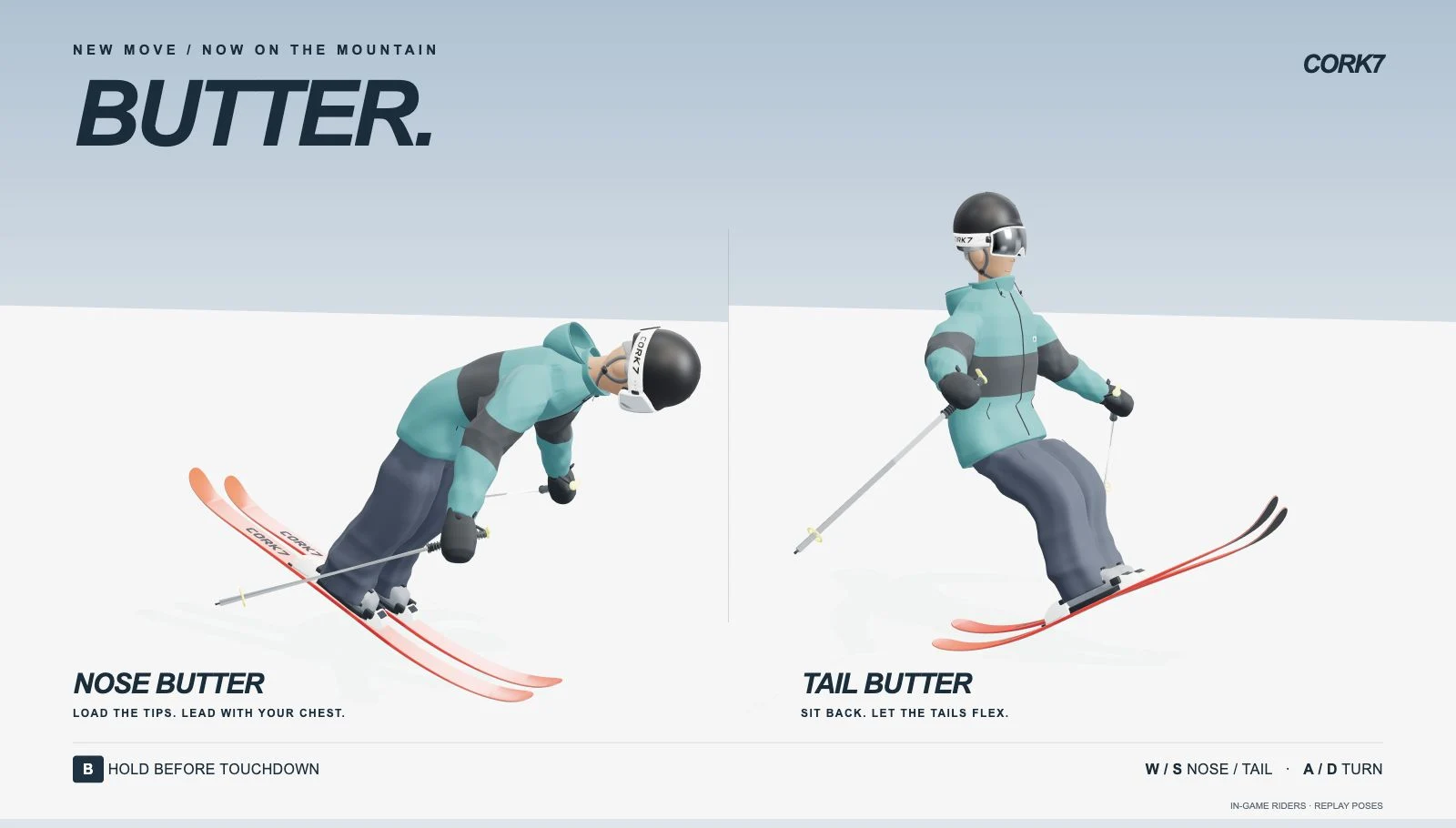
Butter is a separate snow-contact trick. Hold B before snow contact to prepare a nose butter, or press B together with S to select the tail. Turn with A/D and release B to rebound. The press lasts up to 1.5 seconds and needs a one-second cooldown before a fresh B press. It does not activate on rails or boxes.
Treat a scoring example as a breakdown, not a promised final total. Your completed movement and the rest of the line determine the result.
A small practice plan
Our suggested progression: repeat one manageable jump and add one new action at a time. Your checklist stays in this browser.
Sources
Game controls and features may change. Refer to the original game's current settings and field guide.